 BITCLAKMEDIA KIT
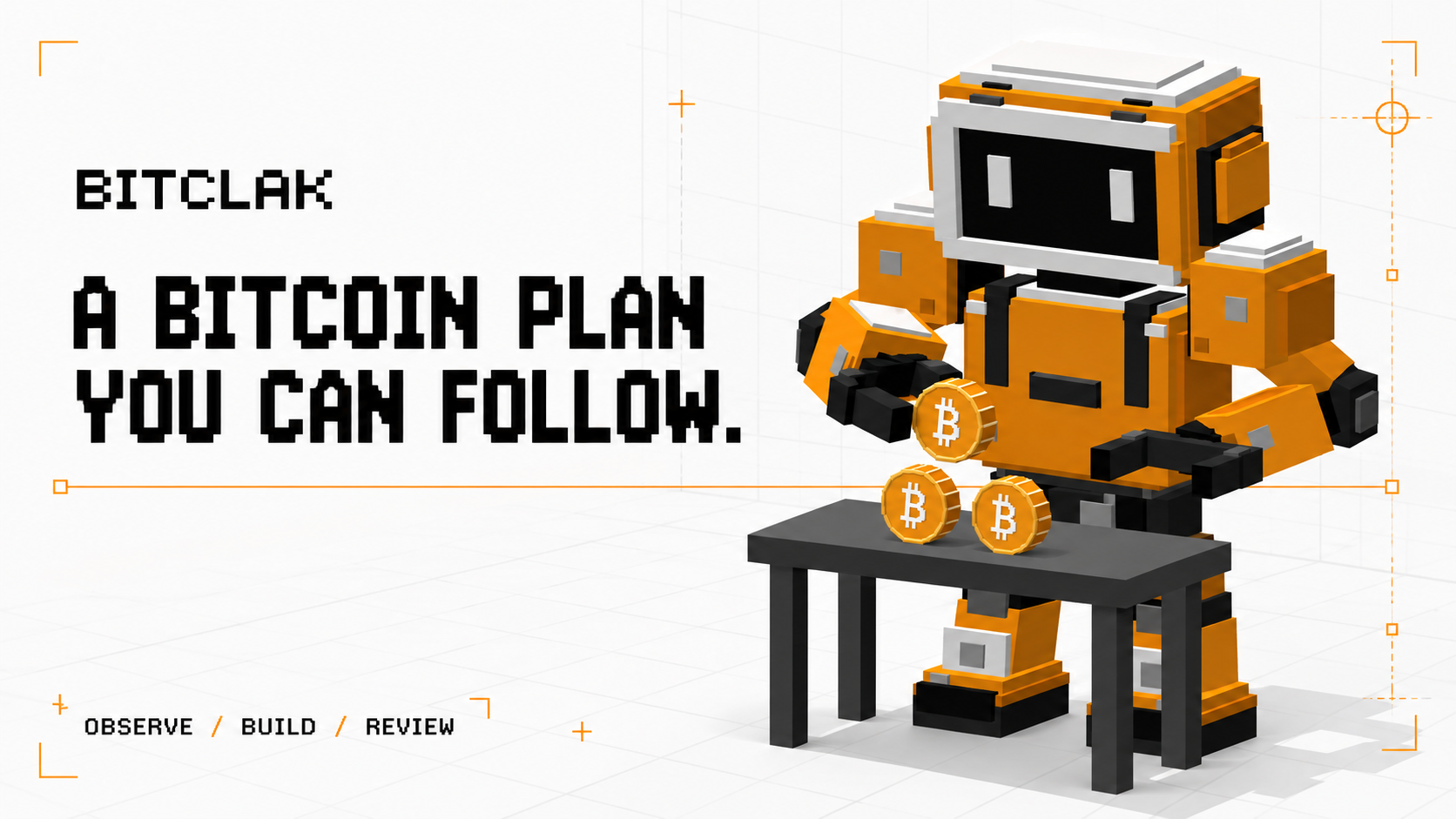
A Bitcoin price tells you where the market is. It does not tell you what your plan should do next. BITCLAK gives that question a place to live: a workshop where you define a routine, set its limits and inspect the reasoning behind each simulated decision.
The first thing you meet is an orange voxel robot. As you scroll, it moves Bitcoin coins across its workbench. The small mechanical sequence introduces the idea behind the platform: observe, apply a rule, record the result. The robot gives the process a character; the workbench makes it something you can use.
Start with an observation
BITCLAK reads public BTC/USD market data from Coinbase Exchange. The market panel brings together price, bid and ask, the 24-hour change, high and low, and exchange-specific Bitcoin volume. It also separates the quote timestamp from the time BITCLAK retrieved it, so the observation has a visible source and age.
These are live market observations. Strategy balances, fills and profit or loss are simulated. Opening the workbench does not connect an exchange account, move Bitcoin or place an order. That distinction lets you explore a set of rules without treating a paper result as an executed trade.
Choose a routine you can explain
The workbench offers three routines. Interval attempts a fixed purchase when your chosen cadence is due. It does not fill missed rounds retrospectively. Return looks for an entry below the average of six earlier qualified observations, then an exit when the price returns to that average. Breakout looks for a price above the previous six-observation high plus your threshold, with an exit below the previous low.
Return and Breakout need time to build their reference window. BITCLAK collects observations from separate five-minute windows and waits until it has the history the routine requires. A waiting decision is part of the record. The system does not manufacture past candles to make a new agent look active.
Put limits around the plan
An agent starts with a virtual balance, an order size and a daily entry budget. You also set cadence, exposure, stop, target and drawdown limits. Those choices define the conditions the routine must respect when it evaluates a new observation.
The paper model includes a 0.30% fee and a 0.50% adverse price adjustment on simulated fills. These are modeling assumptions, not promised execution terms. Quote checks, available virtual cash and exposure checks can prevent an entry. A drawdown breach locks new entries until you explicitly resume with a new risk baseline.
Read the decision, not just the balance
Each cycle produces a journal entry: buy, sell, hold or blocked, accompanied by its reason. Inspect an agent to see virtual cash, paper Bitcoin, realized profit or loss, modeled fees and the settings that shaped its decisions. The journal makes it possible to understand why a routine waited as well as why it acted.
Up to eight agents can live in one browser workshop. Their settings, observations and decisions are stored locally, and the workshop can be exported as JSON. Automatic cycles run while the tab is visible. Pausing an agent stops all evaluation, including exits; it is a pause in the experiment, not a background trading service.
Every sat. A reason.
BITCLAK makes a plan easier to examine. Start with one routine, choose limits you understand and watch how the rules respond as observations arrive. Keep the decisions, review the assumptions and refine the next experiment. The useful result is a process you can follow, one recorded reason at a time.